


Bagaimana Serbuk Polimer Boleh Disebarkan Semula Menyelesaikan Keretakan Grout Jubin dan Penembusan Air dalam Projek Hospitaliti Pesisir
A tile grout manufacturer supplying a large hospitality development on a tropical coastline was receiving persistent complaints from the tiling contractor. Grout joints on external terrace areas and pool surrounds were cracking within three to four months of installation — concentrated at tile corners and along edges where differential thermal movement between the large-format porcelain tiles and the substrate was greatest. In wet areas including shower rooms and pool-level changing facilities, water was penetrating through the cracked joints and causing efflorescence and substrate staining visible on the facade below.
The project specification required a cementitious grout with Class CG2WA performance under EN13888 — high cement content, water resistance, and reduced water absorption. The manufacturer's existing formulation was achieving CG2 classification in laboratory testing but failing in field conditions, suggesting the lab performance was marginal and real-world thermal cycling and moisture exposure were exposing the gap between specification and actual durability.
Root Cause Analysis
After reviewing the formulation and the failure pattern, two issues were identified.
Insufficient polymer content. The existing formulation used RDP powder at 1.2% of dry mix — below the threshold needed for continuous polymer film formation in a fine-aggregate grout matrix. Without a continuous flexible film, the grout behaved as a rigid cementitious material with no capacity to absorb the differential movement generated by 600x600mm porcelain tiles cycling through daily temperature swings of 35°C on a sun-exposed coastal terrace. The cracking pattern — concentrated at tile corners and edges — was consistent with thermal movement stress exceeding the tensile capacity of an unmodified cement matrix.
No hydrophobic component. The formulation contained no water-repellent additive. For a coastal application with direct sea spray exposure and permanent wet-area use, water absorption through the grout joint was inevitable without active hydrophobic modification. The efflorescence visible on the facade confirmed that water was not just entering the joint but transporting soluble salts from the substrate through it.
The Solution
We recommended two changes to the formulation.
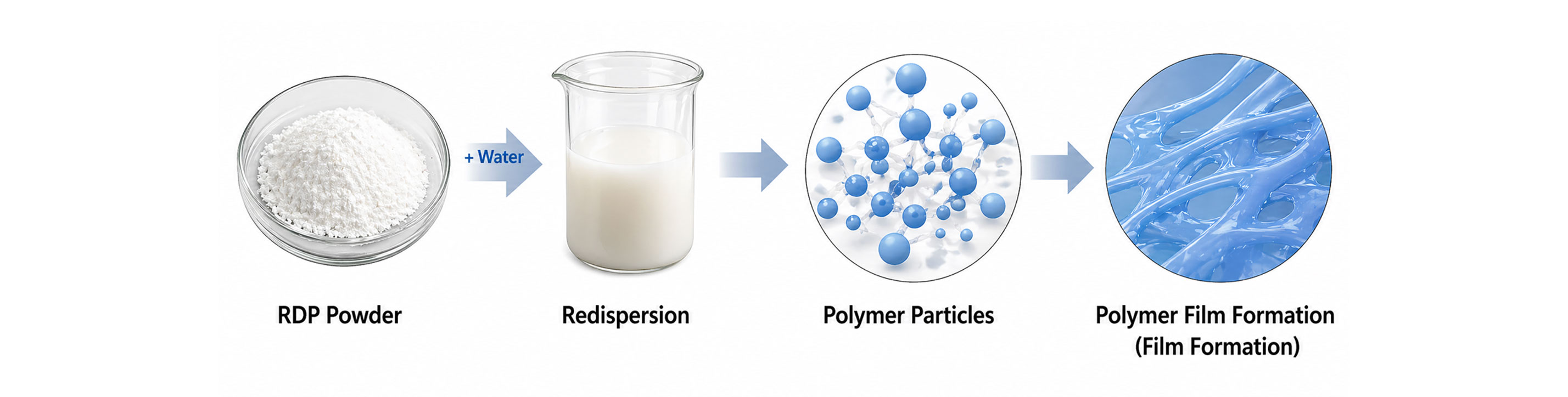
First, increase VAE redispersible polymer powder to 3.5% of dry mix. At this dosage, polymer film formation is continuous and consistent across the grout joint cross-section — producing the flexibility needed to absorb thermal movement without cracking. The target was transverse deformation above 1.5mm under EN12808 testing, which the revised formulation achieved at 2.1mm.
Second, add a silicone hydrophobic powder at 0.5% to provide integral water repellency. This reduced water absorption from 18% to under 3% in 30-minute immersion testing — comfortably within the CG2WA specification requirement of less than 5%.
Revised Formulation
| Raw Material | Previous (%) | Revised (%) |
|---|---|---|
| Simen Putih | 30 | 28 |
| Pasir Kuarza Bergred | 64.8 | 63.5 |
| Serbuk Polimer Boleh Disebarkan Semula | 1.2 | 3.5 |
| HPMC | 0.20 | 0.25 |
| Serbuk Hidrofobik Silikon | 0 | 0.50 |
| Perencat Asid Sitrik | 0.10 | 0.10 |
| Titanium Dioksida (putih) | 3.70 | 4.15 |
Keputusan
| Petunjuk Prestasi | Sebelumnya | Disemak semula |
|---|---|---|
| Ubah Bentuk Melintang | 0.6 mm | 2.1 mm |
| Penyerapan Air (30 minit) | 18% | 2.8% |
| Kekuatan Fleksibel (28 hari) | 3.2 MPa | 4.8 MPa |
| Pengelasan EN13888 | CG2 | CG2WA |
| Retakan Lapangan (6 bulan) | Kerap | Sifar |
Maklum Balas Pelanggan
"Retakan itu menyebabkan masalah serius kepada kami dengan pelanggan projek — teres pantai dan kawasan kolam renang adalah lokasi yang mudah dilihat dan kegagalan grout adalah mustahil untuk diabaikan. Selepas membuat formulasi semula dengan dos RDP yang lebih tinggi dan komponen hidrofobik, kami tidak menerima sebarang aduan keretakan sepanjang enam bulan pemantauan di kawasan yang telah dipulihkan dan pada dua projek berikutnya yang menggunakan formulasi yang sama."
— Pengurus Pembangunan Produk, Pengilang Grout Jubin
Kesimpulan
Bagi pengeluar grout jubin yang menyasarkan klasifikasi CG2WA dalam aplikasi kawasan pantai dan basah yang mencabar,Campuran grout jubin serbuk RDPdos dan pengubahsuaian hidrofobik adalah dua pembolehubah formulasi yang menentukan sama ada pengelasan makmal diterjemahkan kepada ketahanan dunia sebenar. Sebagai pembekal fleksibiliti grout serbuk polimer boleh larut semula yang berdedikasi, kami menyediakanSerbuk polimer boleh larut semula VAEdengan prestasi Tg dan pembentukan filem yang konsisten, dokumentasi COA penuh dan sokongan formulasi untuk semua peringkat pengelasan grout.
Hubungi kami untuk meminta sampel, helaian data teknikal atau rundingan formulasi.